Hosted by Kerstin Kaufmann (HU)
Prof. Léo Guignard
Marseille Developmental Biology Institute - Computer Science, Morphogenesis and Variability Group
Léo Guignard is a computational biologist from the Marseille Developmental Biology Institute in France, working at the interface of computer science and developmental biology. His research focuses on understanding how cells organize, communicate, and change over space and time during embryonic development. Thereby his Group addresses a fundamental question in developmental biology: how can an organism reliably build the same complex form despite the inherent variability of biological systems? To answer this question, he develops computational approaches that transform complex imaging and spatial data into quantitative descriptions of morphogenesis. By reconstructing development across space and time and comparing developmental trajectories between individuals and species, his research provides a quantitative framework for understanding how biological form emerges and how reproducible development really is.
In his talk 'A quantitative view of cell lineages' Léo Guignard will take you to the world of Lineage tracing, which has long been the holy grail for biologists aiming to unravel how a single cell develops into a complex organism. While John Sulston’s pioneered manual reconstruction of C. elegans lineages and showcased the potential of such complex dataset, modern acquisition systems, such as fluorescence light-sheet imaging, now generate terabyte-scale datasets for intricate organisms like zebrafish, mice, and Drosophila.
Recent years have seen major advances in algorithms for automatically or semi-automatically reconstructing cell lineages, producing highly complex spatio-temporal datasets. Yet, what has remained elusive are effective tools for manipulating, querying, and characterizing these datasets.
In his presentation, he will introduce lineagetree and napari-ReLAX (Reconstructed Lineages Analysis and eXploration), two open-source Python libraries designed for seamless, hassle-free exploration of any tracking dataset. He will then introduce the unordered constrained tree edit distance which allows to measure in an agnostic manner any two cell lineage trees (or tree-like structures). Finally, he will showcase the usefulness of this metric across multiple example in C. elegans, P. hawaiensis and other systems.
On the 10th of September, we were very happy to welcome Léo Guignard back to Humboldt-Universität — this time as a guest of Kerstin Kaufmann’s group. Léo previously worked at HU in the group of Dagmar Kainmueller, where he began his research on Drosophila development. His return offered a welcome opportunity to reconnect, exchange ideas and, of course, get to know each other over some warm beverages before the scientific programme began.
Léo gave a fascinating talk on his work at the intersection of developmental biology, imaging and computational analysis, focusing on a fundamental question: how variable is development, and how can we actually measure that variability? Development may look remarkably reproducible. Starting from just a handful of cells, embryos develop into highly organized organisms with precisely positioned tissues and organs. Yet, when we look closely, development is anything but identical from one embryo to the next. Cells can differ in where and when they divide, how they move and which genes they express.
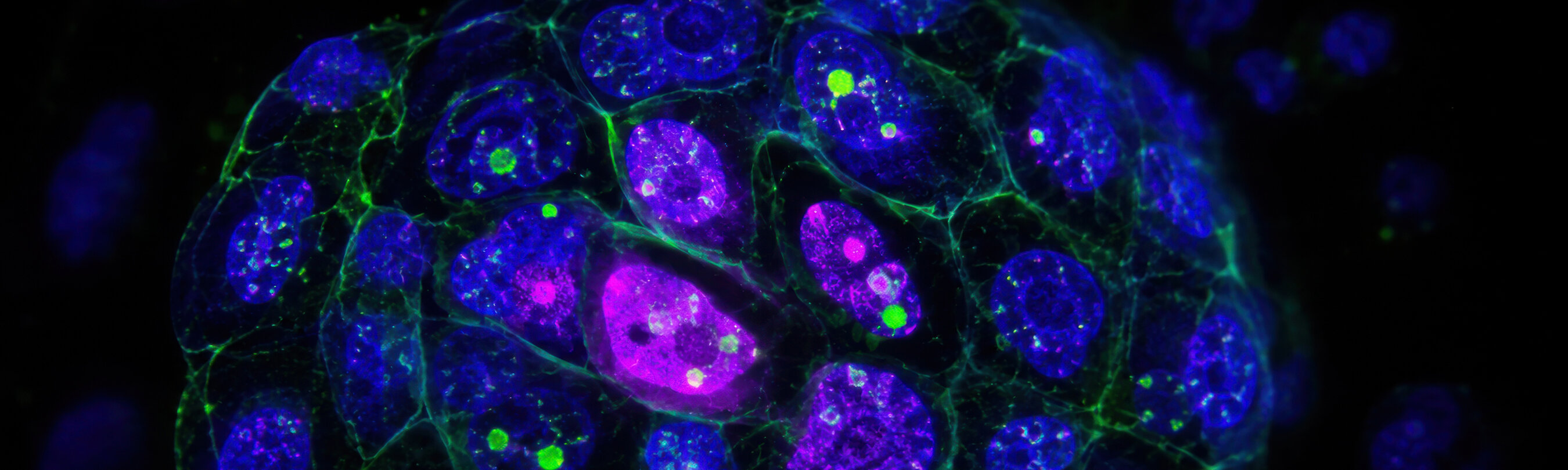
A particularly intriguing example comes from the early development of Parhyale hawaiensis, an amphipod crustacean — or, as Léo put it, a kind of shrimp. Starting from just eight cells, its embryos develop a defined tissue architecture over the following days. By tracking individual cells, Léo’s group can reconstruct their lineages and follow changes in position, movement, division patterns and gene expression over time. But comparing embryos is not as simple as comparing two maps. Cells do not always divide in the same way or end up in the same positions, making it surprisingly difficult to determine which cells should actually be compared.
Léo’s computational approaches address this challenge by treating cell lineages as branching structures and identifying meaningful correspondences even when developmental trajectories differ. By combining lineage information with cell position, movement, cell-cycle behaviour, gene expression and increasingly spatial omics, these methods provide new ways to investigate where developmental variability arises, how it changes over time, and how embryos respond to perturbations. For example, what happens when a cell is removed early in development? Can the embryo compensate and return to a typical trajectory, or does it begin to diverge? Questions like these highlight how combining detailed imaging with computational analysis can reveal not only how embryos develop, but also how flexible development really is.
After the talk, the discussions continued over a well-deserved lunch, with plenty of opportunities to exchange ideas beyond the presentation. Throughout the day, Léo also met with various interested scientists of our Group, continuing conversations in offices and labs and over dinner. These informal exchanges provided further opportunities to discuss research, share perspectives and explore common interests. All in all, it was a very successful and inspiring visit!
The following day, Léo joined us again for the doctoral defence of Manuel Neumann from Kerstin Kaufmann’s group, where he served as one of the examiners. It was a fitting continuation of his visit: after spending the previous day discussing how we can understand the dynamics and variability of development, we had the opportunity to celebrate the culmination of Manuel’s own research journey.
We were very happy to have Léo with us — to learn more about his research, discuss different perspectives on development and quantitative biology, and explore the connections between our scientific interests. We hope this will not be the last opportunity for further exchange!