Knock, Knock — It’s Queuine!
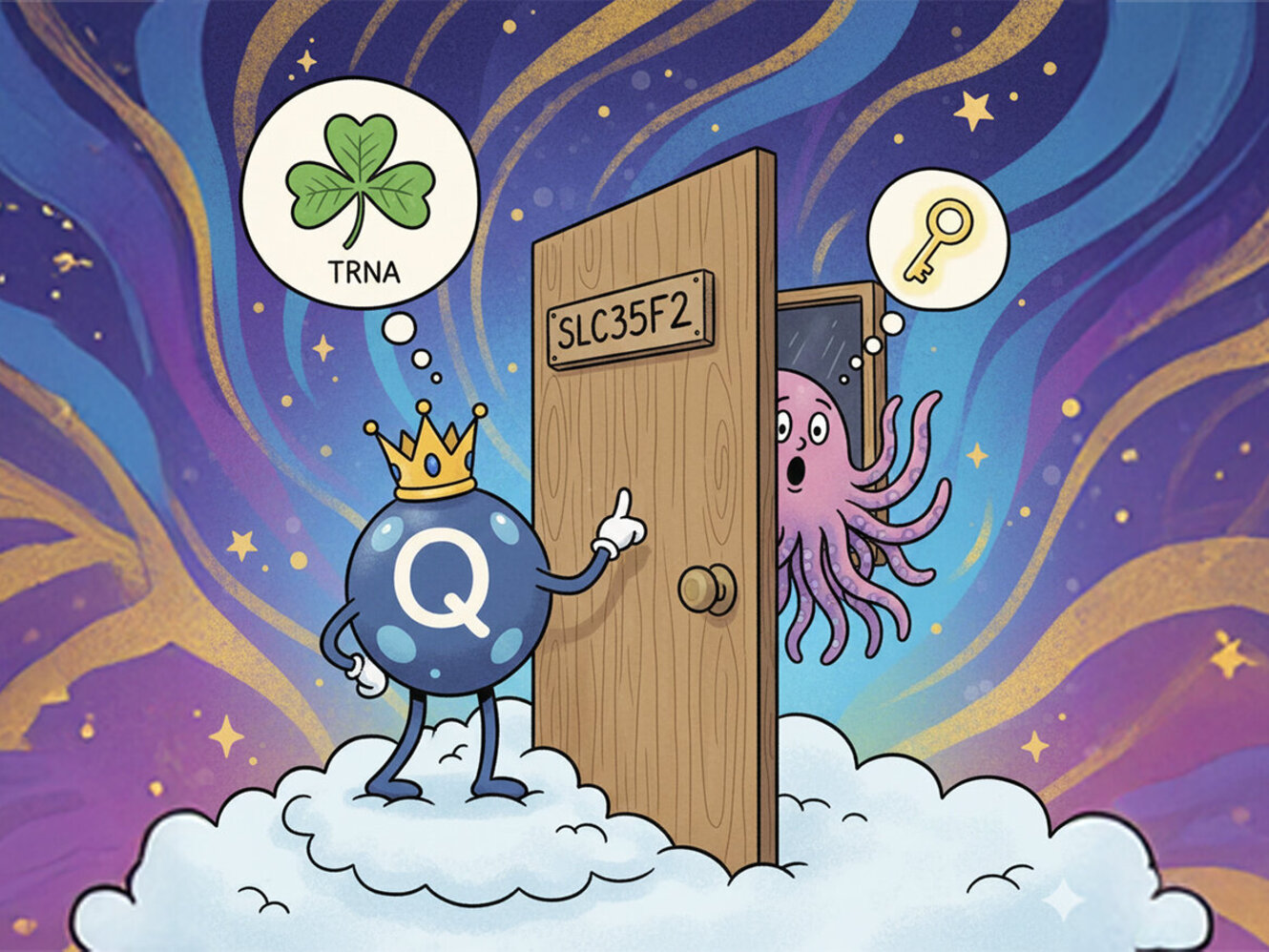
Some of the molecules our cells rely on come not from us, but from bacteria. Queuine is one such micronutrient—an essential building block for modifying tRNAs so they can translate proteins efficiently. Despite its importance and links to neurological disorders and cancer, one basic question has remained unanswered: how do human cells take up queuine? The Molecular Cell Biology Group (Ann Ehrenhofer-Murray) identified SLC35F2 as the long-sought transporter for both queuine and its nucleoside form, queuosine. Using cross-species bioinformatics, genetics, and uptake assays, they show that SLC35F2 is highly specific, acts as the main transporter in human cells, and localizes to the plasma membrane and Golgi. This discovery reveals how cells control queuine levels and provides new insight into its role in health and disease.
Abstract
The nucleobase queuine (q) and its nucleoside queuosine (Q) are micronutrients derived from bacteria that are acquired from the gut microbiome and/or diet in humans. Following cellular uptake, Q is incorporated at the wobble base (position 34) of tRNAs that decode histidine, tyrosine, aspartate, and asparagine codons, which is important for efficient translation. Early studies suggested that cytosolic uptake of queuine is mediated by a selective transporter that is regulated by mitogenic signals, but the identity of this transporter has remained elusive. Here, through a cross-species bioinformatic search and genetic validation, we have identified the solute carrier family member SLC35F2 as a unique transporter for both queuine and queuosine in Schizosaccharomyces pombe and Trypanosoma brucei. Furthermore, gene disruption in human HeLa cells revealed that SLC35F2 is the sole transporter for queuosine (Km 174 nM) and a high-affinity transporter for the queuine nucleobase (Km 67 nM), with the additional presence of second low-affinity queuine transporter (Km 259 nM). Ectopic expression of labeled SLC35F2 reveals localization to the cell membrane and Golgi apparatus via immunofluorescence. Competition uptake studies show that SLC35F2 is not a general transporter for other canonical ribonucleobases or ribonucleosides but selectively imports q and Q. The identification of SLC35F2, an oncogene, as the transporter of both q and Q advances our understanding of how intracellular levels of queuine and queuosine are regulated and how their deficiency contributes to a variety of pathophysiological conditions, including neurological disorders and cancer.