Second Mini-Symposium on Stochastic Decision Making
Symposia are a valuable opportunity to exchange ideas, spark new collaborations, and strengthen scientific communities. Our symposium aimed to bring together researchers who share an interest in Stochastic Decision Making (SDM), while also welcoming fresh perspectives from scientists working across different disciplines.
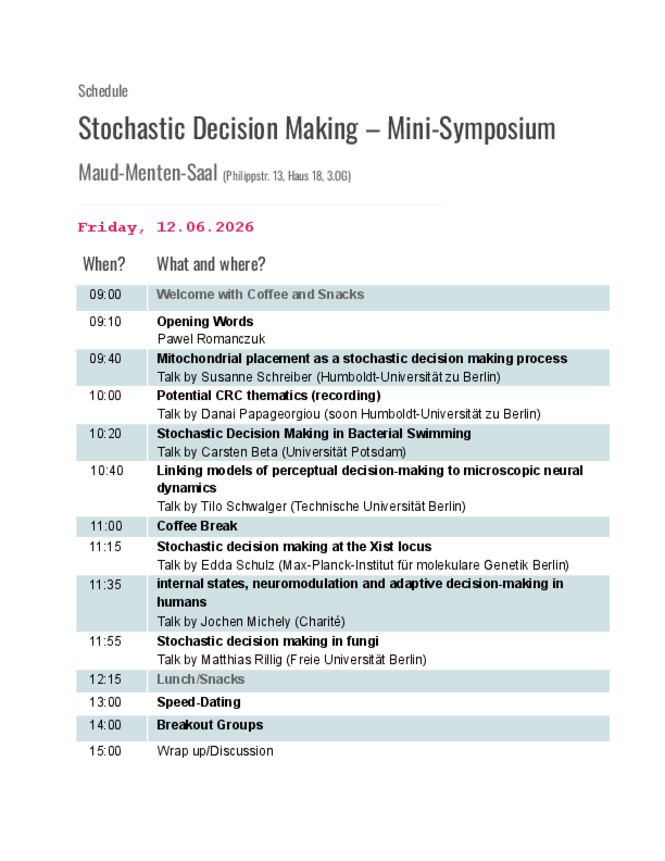
Following a welcome and introduction by Pawel Romanczuk, we kicked off the scientific program with a series of short talks. These presentations gave participants the chance to introduce themselves, share their research interests, and discuss how stochastic decision making relates to their work.
Susanne Schreiber (Humboldt-Universität zu Berlin) presented mitochondrial placement as a stochastic decision-making process, highlighting how cells may use probabilistic mechanisms to organize energy distribution.
Danai Papageorgiou (soon Humboldt-Universität zu Berlin) discussed potential thematic directions for a future Collaborative Research Centre (CRC) and explored how SDM could provide a unifying framework across disciplines.
Carsten Beta (Universität Potsdam) examined stochastic decision making in bacterial swimming, showing how microorganisms navigate complex environments through noisy sensory information and behavioral variability.
Tilo Schwalger (Technische Universität Berlin) explored how mathematical models of perceptual decision-making can be linked to the microscopic dynamics of neural activity.
After a short coffee break, the talks continued.
Edda Schulz (Max Planck Institute for Molecular Genetics, Berlin) presented work on stochastic decision making at the Xist locus, shedding light on the probabilistic mechanisms underlying gene regulation and cell fate decisions.
Jochen Michely (Charité) discussed how internal states and neuromodulatory processes shape adaptive decision-making in humans under uncertainty.
Matthias Rillig (Freie Universität Berlin) offered a fascinating perspective on stochastic decision making in fungi, illustrating how seemingly simple organisms can exhibit complex and adaptive behaviors.
During the coffee and lunch breaks, the first lively conversations and discussions quickly emerged, providing opportunities to connect beyond the formal presentations.
In the afternoon, we moved into our "Scientific Speed Dating" session. This format gives established members the opportunity to meet potential new members in a series of short one-on-one discussions, helping to identify shared interests and possible points of collaboration. As always, the session proved highly productive—it was often difficult to interrupt conversations when it was time to switch partners.
The speed dating session was followed by dedicated time for further discussions in smaller groups, allowing participants to continue conversations, develop ideas, and explore potential collaborations in more depth.
We concluded the symposium with a wrap-up session to collect feedback, ideas, and key takeaways from what proved to be a highly engaging and productive meeting. We would like to thank everyone who took the time to participate and for the many valuable contributions, discussions, and insights that made the event such a success.