The Quantum U-turn
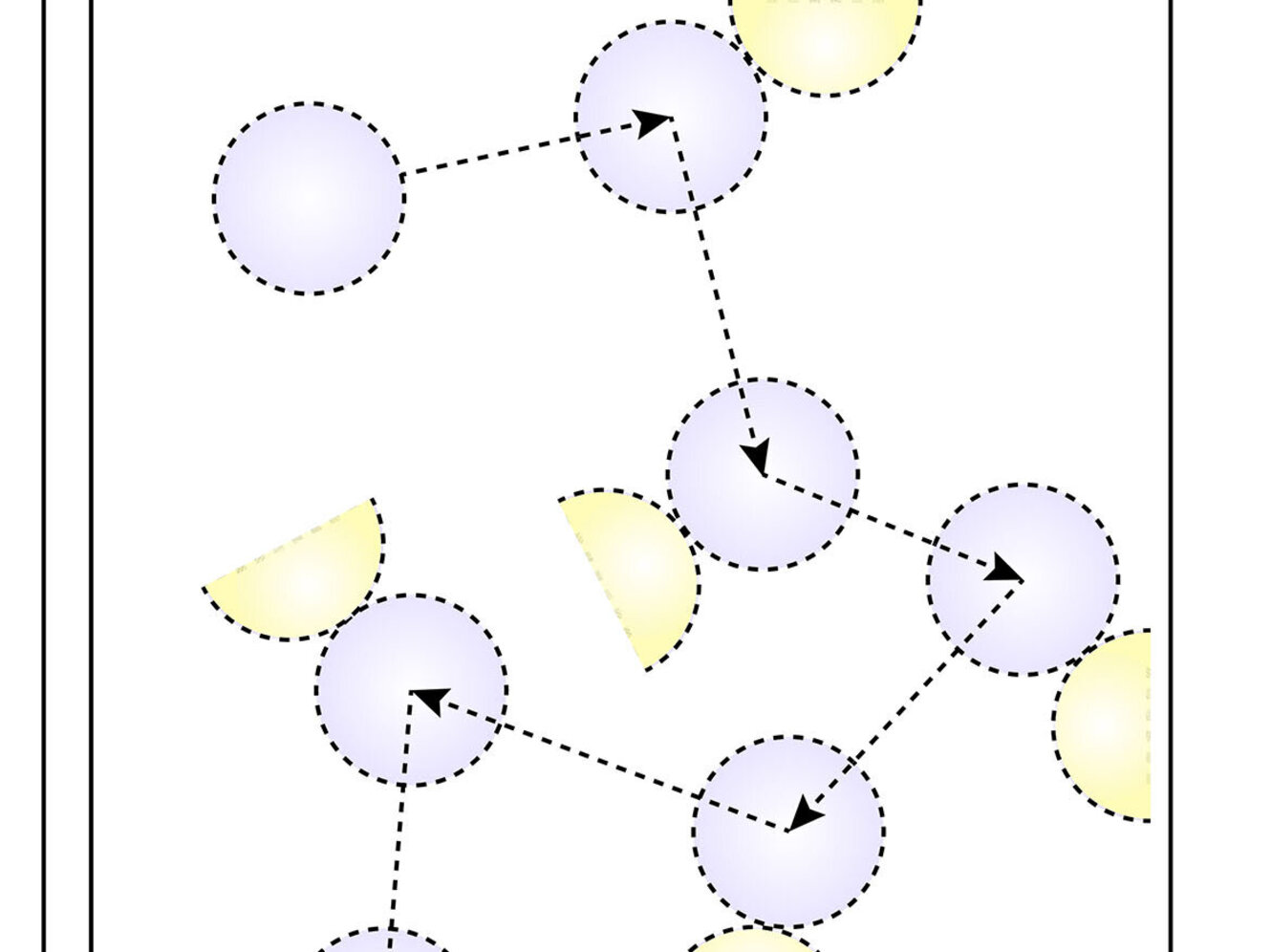
How do microscopic particles move through quantum systems when we give them a sudden nudge? The Statistical Physics and Nonlinear Dynamics Group (Igor Sokolov) explored the physics of how quasiparticles travel across different theoretical structures. By comparing quantum mathematical models to classical random motion, they revealed that quantum particles can spread out in ways that look like a Lévy walk. Depending on whether these particles interact with surrounding vibrations (phonons) or encounter random obstacles, their physical spread can transition from a rapid, unimpeded "ballistic" surge to a slower, classical shuffle known as standard diffusion. Find out more about the movement of quasiparticles in their Article.
Abstract
We analyze the transport properties of quasiparticles locally excited at an initial time moment in several exactly solvable quantum models. It is revealed that, in the investigated quantum systems, the time-dependent probability distribution function (PDF) exhibits behavior similar to that of classical continuous-time random walk (CTRW) models, such as Lévy walks or diffusing diffusivity. For initially excited quasiparticles interacting with the same two-dimensional phonon reservoir, the exact quantum PDF reveals a U-shaped profile due to the presence of a strong ballistic component. This ballistic component arises because the absolute value of the quasiparticle velocity is bounded from above, allowing quantum coherence effects—stemming from the interaction with the common reservoir—to play a significant role. The results obtained for the phonon-assisted hopping quantum model are compared with three alternative approaches: (i) a simple tight-binding model, (ii) a model of a heterogeneous ensemble of chains with Gaussian random hopping amplitude, and (iii) a tight binding model with random time-dependent hopping amplitude. It is found that the PDF of the simple tight-binding model is similar to that of the phonon assisted hopping model. For the heterogeneous ensemble of chains with a Gaussian distribution of hopping amplitudes, the PDF transforms from bimodal to monomodal via an intermediate trimodal shape as the parameters of the Gaussian distribution are varied. The spread of the PDF is ballistic for the first and the second models mentioned above. For the model with random time dependent classical hopping amplitude, the PDF of quasiparticle spreading exhibits universal asymptotics with logarithmic corrections and resembles the diffusing diffusivity model, characterized by diffusive spread.