Hosted by Edda Klipp (HU)
Prof. Suckjoon Jun
University of California San Diego - Department of Physics
Suckjoon Jun is Professor of Physics at the University of California San Diego and leads a multidisciplinary research group that explores one of biology’s most fundamental questions: how one cell becomes two. His lab combines physics, engineering, and biology to uncover the quantitative principles that govern cellular life.
Driven by curiosity rather than methods, Suckjoon Jun's team develops new tools when existing ones fall short - most notably the microfluidic mother machine, which has transformed single-cell physiology studies. Among their key conceptual advances is the discovery of the adder principle in cell-size control, a central concept in understanding how cells maintain size homeostasis. Today, the Jun Lab continues to push the boundaries of quantitative microbial physiology, investigating how cells allocate resources and achieve precision control across the three domains of life.
In his talk 'On balanced growth and precision control' Suckjoon Jun talked about the two core principles that underlie bacterial physiology. The first, articulated in the 1950s, is balanced growth - the idea that all cellular components increase at the same rate. The second is precision control -- the cell’s ability to coordinate spatial and temporal events, such as DNA replication and division, with remarkable accuracy. Reconciling these two principles poses a conceptual challenge rarely addressed in biology textbooks. During his talk he showed how bacteria achieve physiological homeostasis and precise regulation under balanced growth, revealing mechanisms fundamentally different from those emphasized in eukaryote-centric models.

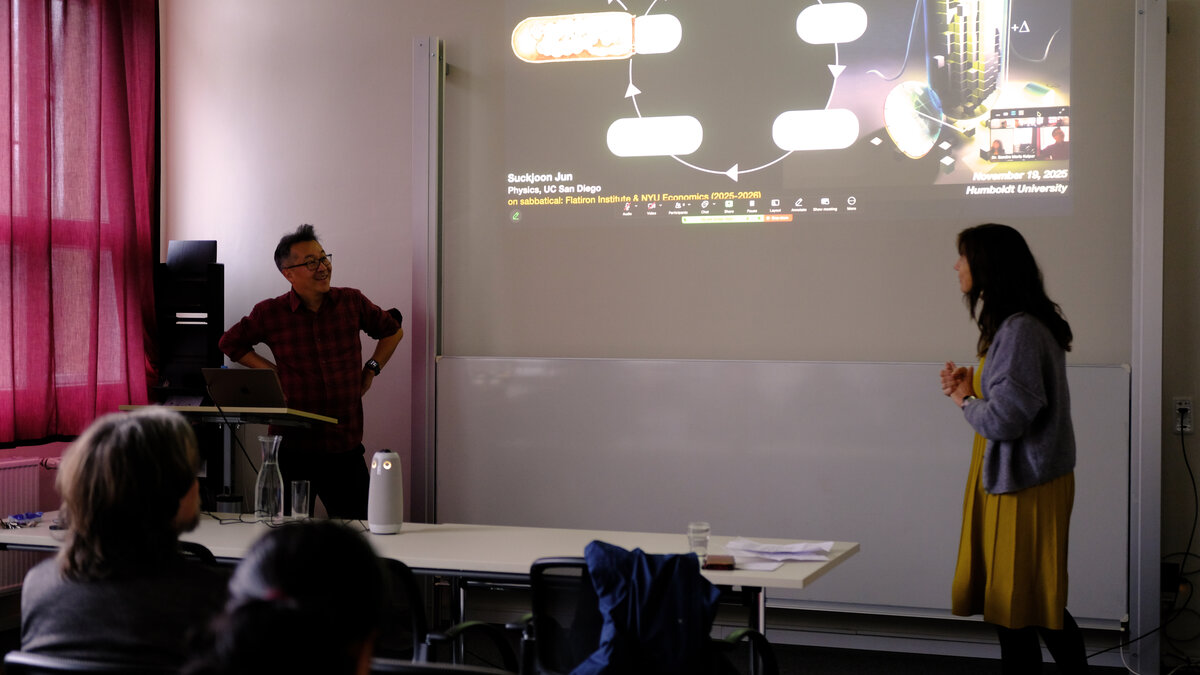

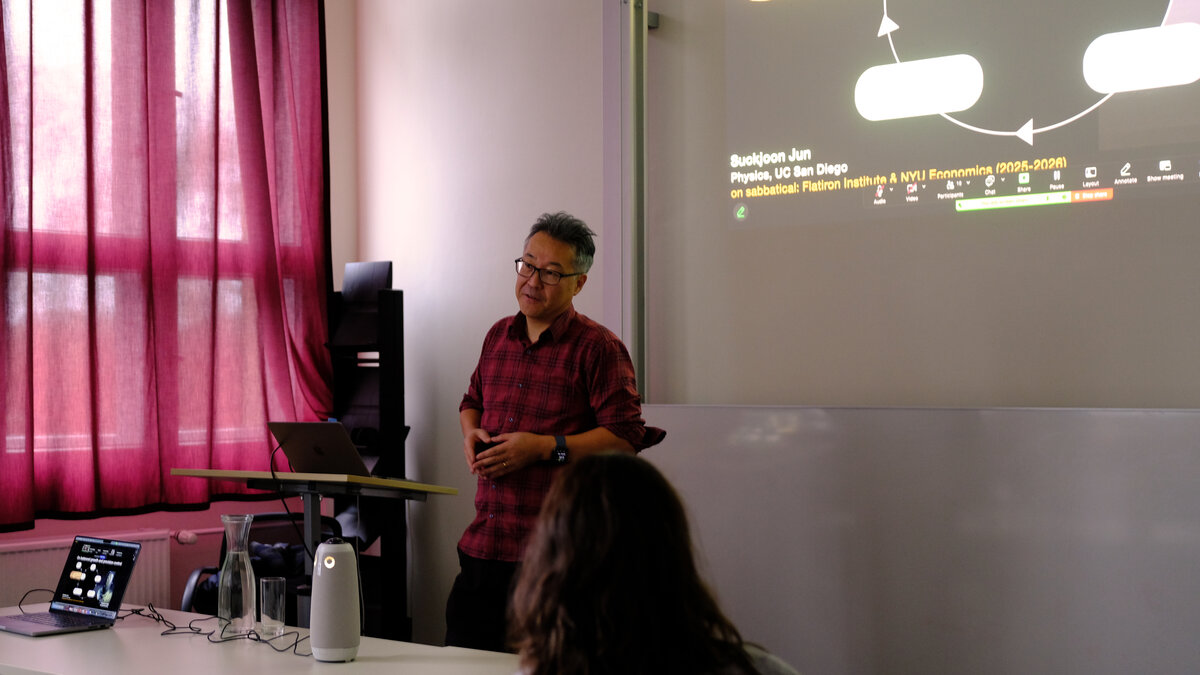
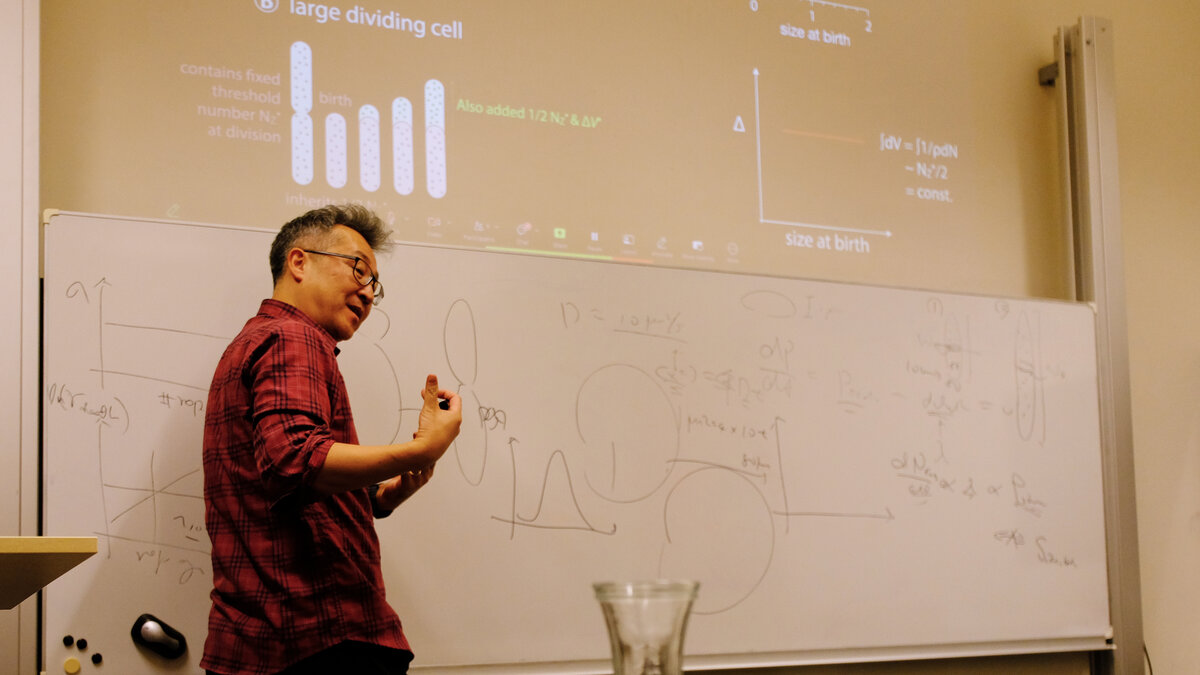
Once he arrived in Berlin, Suckjoon Jun made his way to the group of his host, Edda Klipp, where he was welcomed with great anticipation. After initial discussions with Edda and some of her group members, they headed to the Campus Nord and the Maud-Menten-Saal, where an engaged audience—both on-site and online—was awaiting his talk.
In his lecture, Jun led the audience through his quantitative perspective on bacterial physiology, beginning with the limitations of concentration-based control models and moving toward the central role of balanced biosynthesis. He illustrated how protein concentrations remain remarkably constant during the cell cycle and explained how cells instead 'count' absolute molecule numbers to trigger key processes such as cell division and replication initiation. Using long-term single-cell data from mother-machine experiments, he showed how the 'adder' principle emerges naturally from this counting mechanism.
Suckjoon Jun also discussed how E. coli achieves striking precision in replication initiation despite molecular noise, revealing a titration-based mechanism involving DnaA binding sites across the chromosome. He closed by outlining current efforts to extend these physiological principles across all three domains of life and emphasized the collaborative nature of the work.
The talk sparked a lively discussion, and the many questions highlighted the audience’s enthusiasm for the interplay between physics and biology in understanding fundamental cellular behaviors. After the seminar, conversations continued lively over dinner, where scientific questions, new ideas, and future possibilities were exchanged in an even more relaxed atmosphere. The visit also sparked plans for additional meetings with other research groups across the university, many of whom were eager to hear more about Suckjoon Jun’s work and explore potential collaborations. His stay in Berlin thus set the stage for deeper scientific connections that will continue well beyond this fantastic seminar!