Mixed Signals
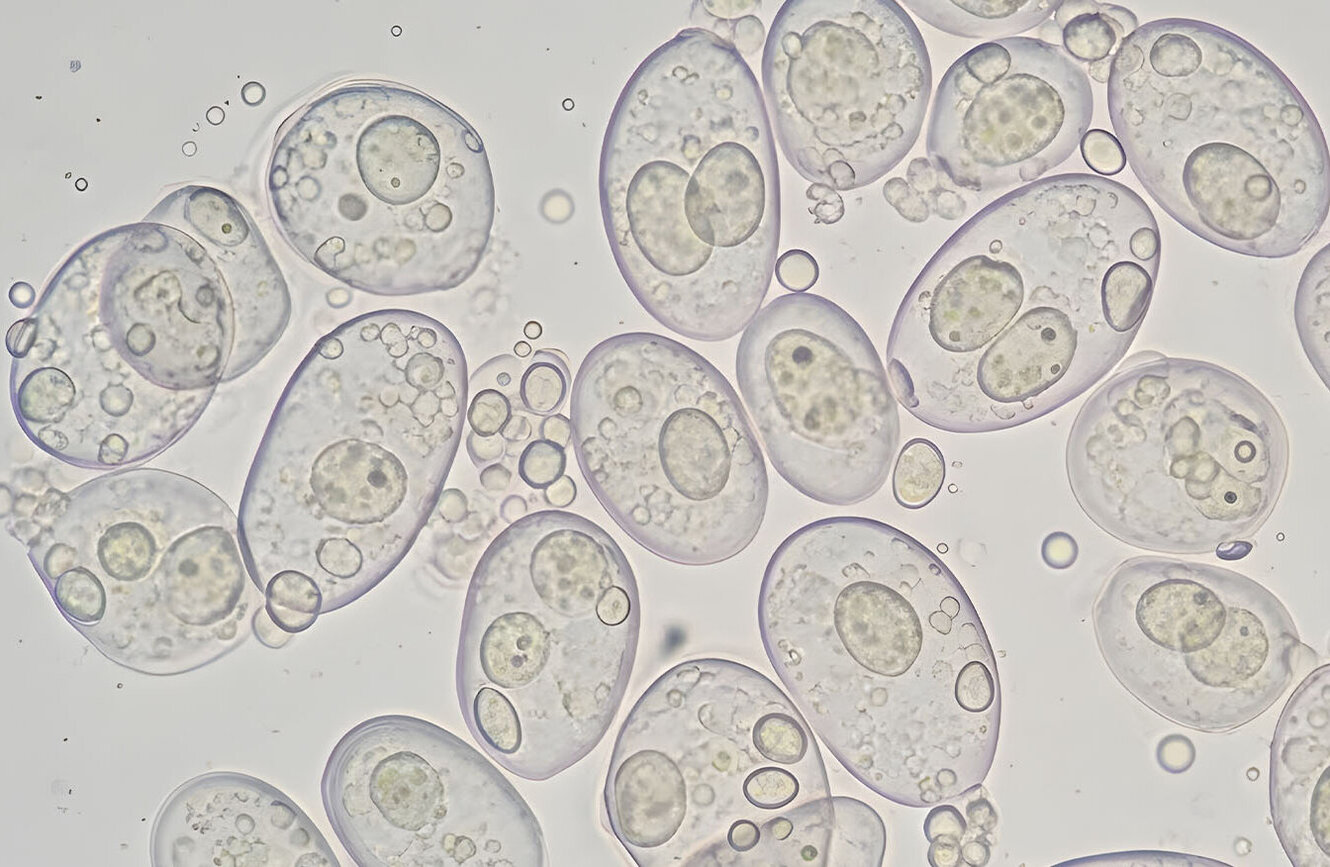
The small GTPase RAS acts as a critical signaling hub that regulates essential cellular processes such as growth and differentiation. Mutations in human RAS isoforms are primary drivers of tumorigenesis and various developmental disorders, typically resulting in the accumulation of active, GTP-bound Ras that can constitutively trigger effector pathways like the MAPK (ERK) cascade. However, recent evidence suggests that oncogenic RAS expressed at physiological levels does not always cause MAPK hyperactivation. The Theoretical Biophysics Group (Edda Klipp) used fission yeast (Schizosaccharomyces pombe) as a model to examine how a constitutively active Ras1 mutation impacts the branched downstream MAPK and Cdc42 pathways during pheromone-induced mating. They revealed that it causes divergent signaling dynamics: it leads to prolonged Cdc42 activation which results in an "elongated shmoo" phenotype where cells grow excessively long conjugation tubes but fail to mate successfully. They also identified a robust negative feedback loop acting on pheromone production or sensing that effectively dampens the MAPK signal even when upstream Ras1 is constitutively active. The findings demonstrate that MAPK cascades possess an inherent resistance to oncogenic RAS mutations under physiological conditions, while other pathways like Cdc42 are more directly impacted. Read the PLOS Genetics Article for further information.
Abstract
The small GTPase RAS is a signalling hub activating multiple pathways, which may respond differently to a constitutively active RAS mutation. We explored this issue in fission yeast, where RAS-mediated pheromone signalling (PS) activates two downstream pathways: the MAPKSpk1 and Cdc42 pathways. We observed that the yeast RAS mutation ras1.G17V, an equivalent of the mammalian ras.G12V oncogenic mutation, causes prolonged Cdc42 activation, whereas MAPKSpk1 activation was transient and attenuated. To explain this observation, we generated a PS framework by conducting genetic epistasis analysis of PS mutants and biochemical analysis of two Ras1 effectors, Cdc42-GEFScd1 and MAPKKKByr2, each of which triggers activation of the Cdc42 and MAPKSpk1 pathways, respectively. Cdc42-GEFScd1 and MAPKKKByr2 directly interacted with Ras1 in vitro in a competitive manner, and overexpression of the Ras binding domain of either Cdc42-GEFScd1 or MAPKKKByr2 in cells inhibited both downstream pathways, confirming that Ras1 signalling branches into the MAPKSpk1 and Cdc42 pathways. In conjunction with the genetic epistasis analysis, we developed the PS framework-based mathematical model to test which network structures can explain the transient MAPKSpk1 activation profile. Incorporating a negative-feedback circuit acting on pheromone production or sensing enabled the model to quantitatively reproduce MAPKSpk1 dynamics in the wild type and 20 additional PS mutants. The predicted PS negative-feedback was experimentally confirmed by deleting Sxa2, the carboxypeptidase that degrades one of the mating pheromones, which led to hyperactivation of both MAPKSpk1 and Cdc42. Our study provides a holistic understanding of the fission yeast pheromone signalling network, explaining how RAS signalling propagates differently through two downstream pathways. Our PS mathematical model may serve as a valuable reference framework for analysing other RAS signalling systems.